How a follicle miniaturises
The same follicle over successive cycles under DHT: a shorter growing phase each time, and a shaft that comes back finer, shorter and less pigmented until it is vellus. Relative sizes are illustrative — the only quantity drawn to scale is the dashed line 20% below the terminal shaft, the diameter diversity trichoscopy looks for. Below it: where DHT comes from, where it binds, and the step the 5-alpha-reductase inhibitors block.
Free to use anywhere, including commercially, with a visible link back to this page. Licensing without the credit line.

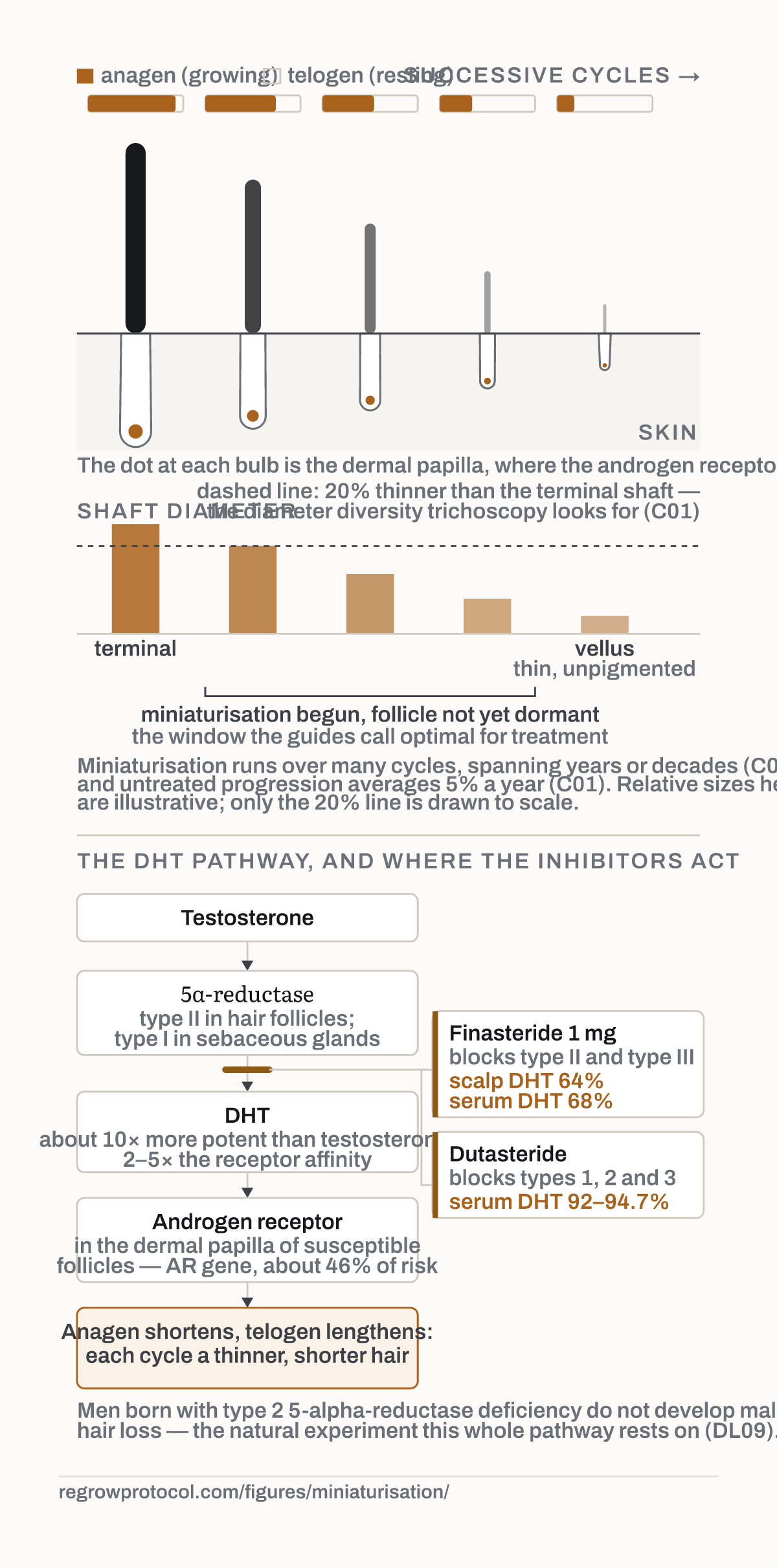
Every number printed on this figure, and where it came from
Each quantity the diagram prints, the sentence it was taken from, and the guide that sentence is in. The build refuses to publish if one of these sentences is no longer in the guide it names.
| Value | What it is, and the sentence behind it | Source guide |
|---|---|---|
| 20% | Hair-diameter variation trichoscopy treats as the diversity criterion “Hair diameter diversity (>20% variation diagnostic)” | Androgenetic Alopecia: Complete Guide |
| 5% a year | Average untreated progression “5% annual loss if untreated” | Androgenetic Alopecia: Complete Guide |
| 10 × testosterone | Relative potency of DHT “DHT is approximately 10 times more potent than testosterone and has 2-5 times higher affinity for androgen receptors.” | DHT and Hair Loss: Complete Explanation |
| 2-5 × receptor affinity | DHT’s affinity for the androgen receptor, relative to testosterone “DHT is approximately 10 times more potent than testosterone and has 2-5 times higher affinity for androgen receptors.” | DHT and Hair Loss: Complete Explanation |
| 46% | Share of genetic risk attributed to the androgen receptor gene “Accounts for roughly 46% of the genetic risk for pattern hair loss” | DHT and Hair Loss: Complete Explanation |
| 1 mg daily | The finasteride dose these DHT reductions were measured at “finasteride 1 mg daily reduces scalp DHT levels by approximately 64% and serum DHT levels by 68%” | Complete Guide to Finasteride for Hair Loss |
| 64% | Scalp DHT reduction on finasteride 1 mg daily “finasteride 1 mg daily reduces scalp DHT levels by approximately 64% and serum DHT levels by 68%” | Complete Guide to Finasteride for Hair Loss |
| 68% | Serum DHT reduction on finasteride 1 mg daily “finasteride 1 mg daily reduces scalp DHT levels by approximately 64% and serum DHT levels by 68%” | Complete Guide to Finasteride for Hair Loss |
| 92-94.7% | Serum DHT reduction on dutasteride “92-94.7% reduction” | DHT and Hair Loss: Complete Explanation |
| 51% | Scalp DHT reduction on dutasteride “dutasteride only reduces scalp DHT by 51%” | DHT and Hair Loss: Complete Explanation |
Where this figure appears
Androgenetic Alopecia: Complete Guide · DHT and Hair Loss: Complete Explanation · Complete Guide to Finasteride for Hair Loss