RegrowProtocol

Figures

The DHT pathway, and where each drug blocks it

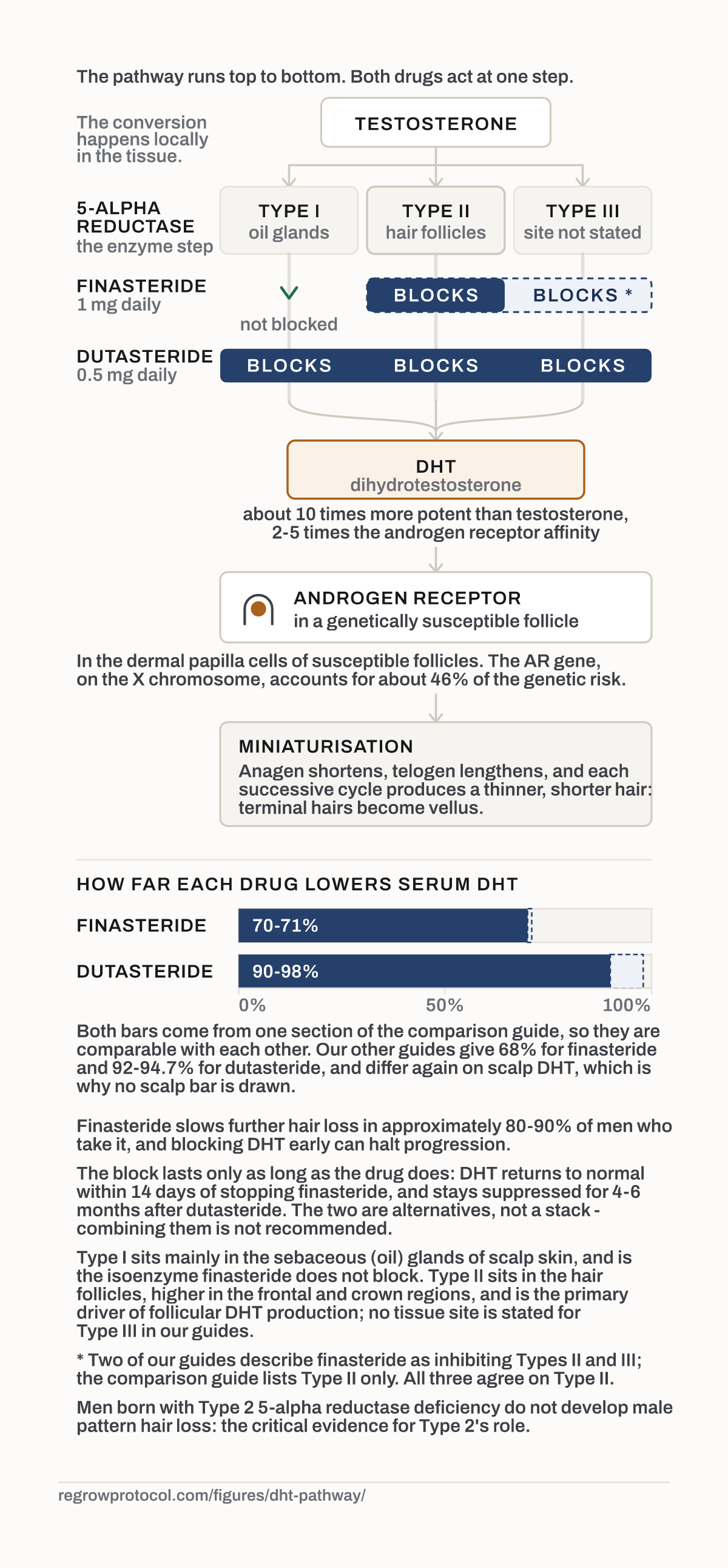
Testosterone becomes DHT at a single enzyme step with three isoenzymes; DHT then binds the androgen receptor in a genetically susceptible follicle, and the follicle miniaturises. Finasteride closes Type II, dutasteride closes all three, which is why lowering DHT slows the loss and why the two drugs lower it by different amounts.

Free to use anywhere, including commercially, with a visible link back to this page. Licensing without the credit line.

The DHT pathway, and where each drug blocks it.
Use this figure on your own site

Free to use anywhere, including commercially, if you keep a visible link back to this page. It is drawn from the sources cited beneath it and follows your reader's light or dark theme.

Open the SVG directly · PNG, 1200px wide · All figures

Every number printed on this figure, and where it came from

Each quantity the diagram prints, the sentence it was taken from, and the guide that sentence is in. The build refuses to publish if one of these sentences is no longer in the guide it names.

ValueWhat it is, and the sentence behind itSource guide
1 mg dailyFinasteride dose printed under the drug name
“The FDA-approved dose for male pattern hair loss is 1 mg taken orally once daily”
Complete Guide to Finasteride for Hair Loss
0.5 mg dailyDutasteride dose printed under the drug name
“dutasteride is used at a dose of 0.5 mg daily”
Dutasteride vs Finasteride: Which Is Better for Hair Loss?
10 x testosteroneDHT potency, printed under the DHT node
“DHT is approximately 10 times more potent than testosterone”
DHT and Hair Loss: Complete Explanation
2-5 xDHT receptor affinity relative to testosterone — the reason the receptor step matters
“has 2-5 times higher affinity for androgen receptors”
DHT and Hair Loss: Complete Explanation
46%Share of genetic risk attributed to the AR gene, printed under the receptor node
“Accounts for roughly 46% of the genetic risk for pattern hair loss”
DHT and Hair Loss: Complete Explanation
70-71%Serum DHT reduction on finasteride — the upper bar
“Serum DHT reduction: 70-71%”
Dutasteride vs Finasteride: Which Is Better for Hair Loss?
90-98%Serum DHT reduction on dutasteride — the lower bar
“Serum DHT reduction: 90-98%”
Dutasteride vs Finasteride: Which Is Better for Hair Loss?
68%The finasteride guide's own serum DHT figure, which is not T02's
“serum DHT levels by 68%”
Complete Guide to Finasteride for Hair Loss
92-94.7%The DHT guide's own serum DHT figure for dutasteride
“Serum: 92-94.7% reduction”
DHT and Hair Loss: Complete Explanation
80-90%Share of men in whom FINASTERIDE slows further loss — the payoff line
“finasteride slows down further hair loss in approximately 80-90% of men who take it”
Complete Guide to Finasteride for Hair Loss
14 daysHow long the block lasts after finasteride is stopped
“DHT returns to normal within 14 days of stopping finasteride”
DHT and Hair Loss: Complete Explanation
4-6 monthsHow long the block lasts after dutasteride is stopped
“DHT remains suppressed for 4-6 months”
Dutasteride vs Finasteride: Which Is Better for Hair Loss?
What is behind the drawing (21 entries)

Shapes carry claims as much as printed numbers do, and some quantities shape the drawing without appearing in it. Each entry below names the sentence that justifies it.

Drawn asThe decision, and the sentence behind itSource guide
sebaceous glandsWhere Type 1 5-alpha reductase sits — the sub-label under the Type I box
“Found primarily in sebaceous glands (oil glands) in scalp skin”
DHT and Hair Loss: Complete Explanation
hair folliclesWhere Type 2 5-alpha reductase sits — the sub-label under the Type II box
“Found in hair follicles of the scalp”
DHT and Hair Loss: Complete Explanation
frontal and vertexWhere Type 2 concentrates, and so where the pattern appears
“Higher concentration in frontal and vertex (crown) regions”
DHT and Hair Loss: Complete Explanation
primary driverWhy Type II is the lane the diagram hinges on
“Primary driver of follicular DHT production”
DHT and Hair Loss: Complete Explanation
no pattern hair lossThe natural experiment printed at the foot of the plate
“men born with Type 2 5-alpha reductase deficiency do not develop male pattern hair loss”
DHT and Hair Loss: Complete Explanation
critical evidenceHow the deficiency finding is described in the guide
“The critical evidence for Type 2's role”
DHT and Hair Loss: Complete Explanation
locally in tissuesWhy the conversion is drawn inside the scalp rather than as a blood-borne supply
“The conversion happens locally in tissues”
DHT and Hair Loss: Complete Explanation
Type IIWhy finasteride's bar is drawn solid across the Type II channel
“Finasteride selectively inhibits Type II 5-alpha reductase”
Dutasteride vs Finasteride: Which Is Better for Hair Loss?
Type II and Type IIIWhy finasteride's bar extends over Type III at all
“Finasteride works by inhibiting Type II and Type III 5-alpha reductase enzymes”
Complete Guide to Finasteride for Hair Loss
Type 2 and Type 3The second guide that describes finasteride as reaching Type III
“Selectively inhibits Type 2 and Type 3 5-alpha reductase”
DHT and Hair Loss: Complete Explanation
not blockedWhy the Type I channel is drawn open under finasteride's bar
“The Type I isoenzyme, which finasteride doesn't block”
Dutasteride vs Finasteride: Which Is Better for Hair Loss?
Types I, II and IIIWhy dutasteride's bar spans all three channels
“dutasteride inhibits all three isoenzymes (Types I, II, and III)”
Dutasteride vs Finasteride: Which Is Better for Hair Loss?
not recommendedWhy the two bars are labelled alternatives rather than a stack
“combining multiple pharmaceutical DHT blockers (like finasteride and dutasteride) is not recommended”
DHT and Hair Loss: Complete Explanation
dermal papillaWhere the receptors sit, printed under the receptor node
“contain androgen receptors in their dermal papilla cells”
DHT and Hair Loss: Complete Explanation
cascade of genetic changesWhat binding starts — the arrow out of the receptor node
“When DHT binds to these receptors, it triggers a cascade of genetic changes”
DHT and Hair Loss: Complete Explanation
genetic sensitivityWhy the receptor node says "genetically susceptible" rather than "everyone"
“The determining factor is genetic sensitivity”
DHT and Hair Loss: Complete Explanation
X chromosomeWhere the AR gene sits, printed under the receptor node
“Located on the X chromosome at position Xq11-q12”
DHT and Hair Loss: Complete Explanation
anagen shorter, telogen longerThe outcome node, line one
“The anagen (growth) phase shortens while the telogen (resting) phase lengthens”
DHT and Hair Loss: Complete Explanation
thinner, shorter each cycleThe outcome node, line two
“Each successive hair cycle produces a thinner, shorter hair”
DHT and Hair Loss: Complete Explanation
terminal to vellusThe end state named in the outcome node
“terminal hairs (thick, pigmented) transform into vellus hairs (thin, unpigmented, barely visible)”
DHT and Hair Loss: Complete Explanation
halt progressionWhy the guides press early treatment
“blocking DHT early can halt progression”
DHT and Hair Loss: Complete Explanation

Where this figure appears

DHT and Hair Loss: Complete Explanation · Complete Guide to Finasteride for Hair Loss · Dutasteride vs Finasteride: Which Is Better for Hair Loss?

Other figures