The six patterns of alopecia areata
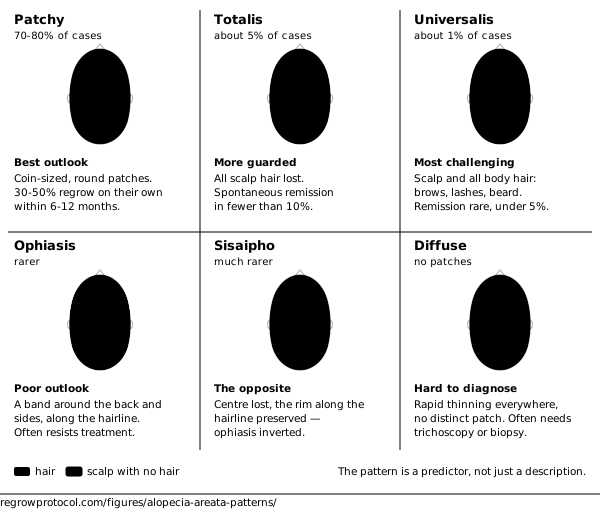
Six heads seen from above, front at the top, each showing one pattern of alopecia areata: patchy, the most common at 70-80 percent of cases; alopecia totalis, the whole scalp, about 5 percent; alopecia universalis, the scalp and all body hair, about 1 percent; ophiasis, a band around the back and sides; sisaipho, the opposite, with the rim preserved and the centre lost; and diffuse alopecia areata, thinning everywhere with no patch to find. The guide's point is that the pattern predicts the response: patchy disease has the best outlook, ophiasis a poor one.
Free to use anywhere, including commercially, with a visible link back to this page. Licensing without the credit line.

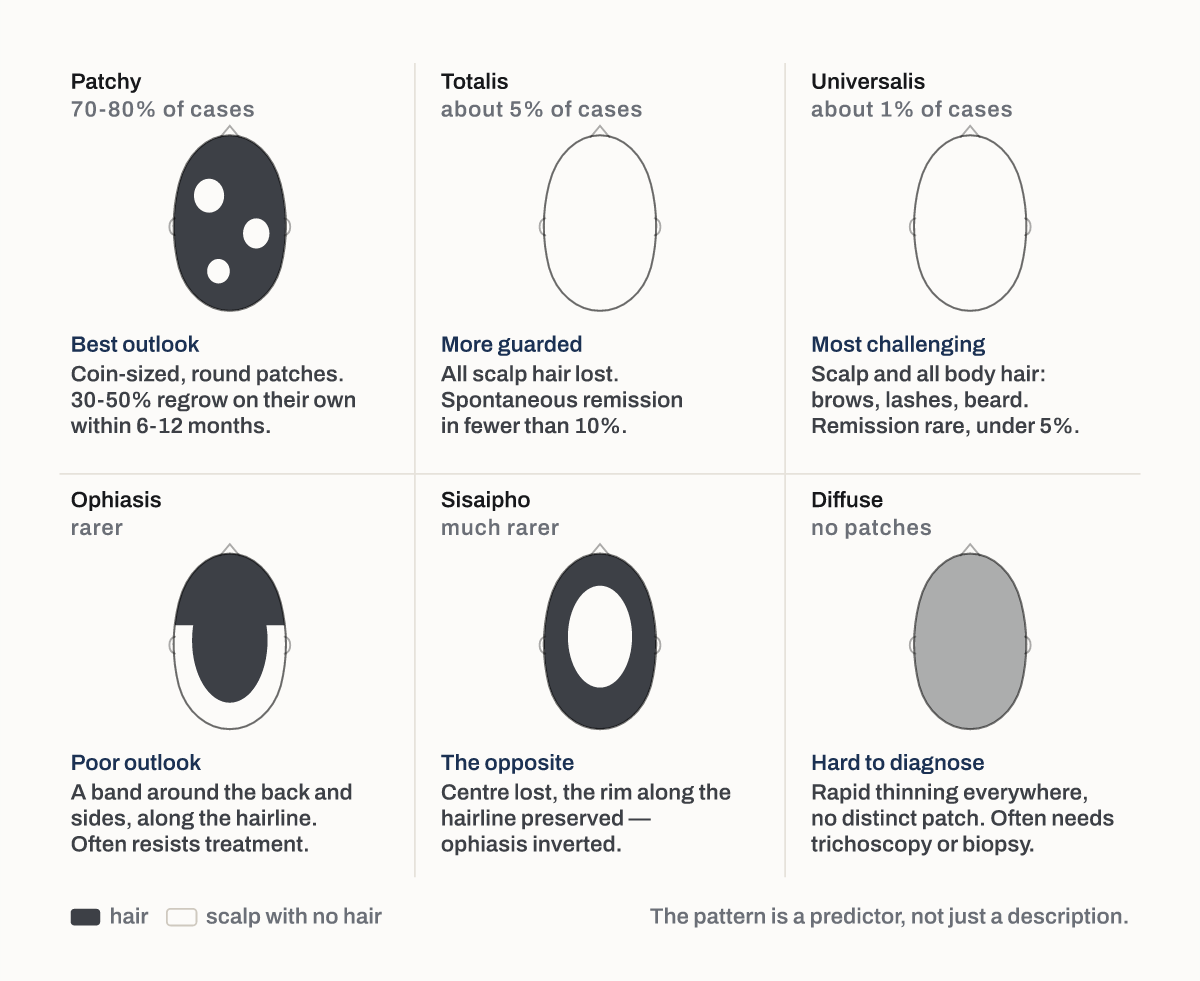
Every number printed on this figure, and where it came from
Each quantity the diagram prints, the sentence it was taken from, and the guide that sentence is in. The build refuses to publish if one of these sentences is no longer in the guide it names.
| Value | What it is, and the sentence behind it | Source guide |
|---|---|---|
| 70-80% | Share of alopecia areata that is the patchy form, printed under the first head “The most common form, affecting 70-80% of people with AA.” | Alopecia Areata: Types, Treatment, and Outlook |
| 30-50% | Share of patchy cases with spontaneous regrowth in the window printed beneath “30-50% experience spontaneous regrowth within 6-12 months” | Alopecia Areata: Types, Treatment, and Outlook |
| 6-12 months | The window over which that regrowth is reported “30-50% experience spontaneous regrowth within 6-12 months” | Alopecia Areata: Types, Treatment, and Outlook |
| 5% | Share of alopecia areata that is totalis “Complete loss of all scalp hair. Affects approximately 5% of people with alopecia areata.” | Alopecia Areata: Types, Treatment, and Outlook |
| <10% | Spontaneous remission in totalis, printed beneath “Spontaneous remission occurs in fewer than 10% of cases.” | Alopecia Areata: Types, Treatment, and Outlook |
| 1% | Share of alopecia areata that is universalis “Affects approximately 1% of AA patients.” | Alopecia Areata: Types, Treatment, and Outlook |
| <5% | Spontaneous remission in universalis, printed beneath “Spontaneous remission is rare (<5%).” | Alopecia Areata: Types, Treatment, and Outlook |
Where this figure appears
Alopecia Areata: Types, Treatment, and Outlook