Why the shedding starts months after the thing that caused it
The published course of acute telogen effluvium on a single linear month axis: the trigger, the lag while the affected hairs sit in telogen, the shedding window, then regrowth and full cosmetic recovery. The arrow marks the gap that makes the cause hard to find. This is the typical course reported in the literature, not a prediction for any individual.
Free to use anywhere, including commercially, with a visible link back to this page. Licensing without the credit line.

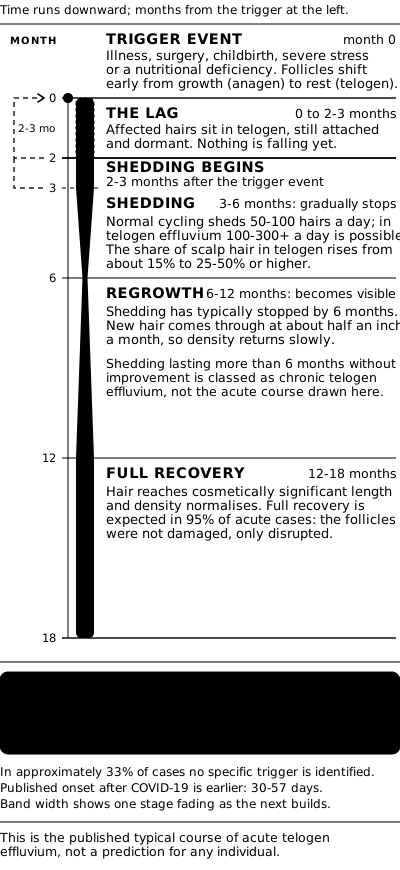
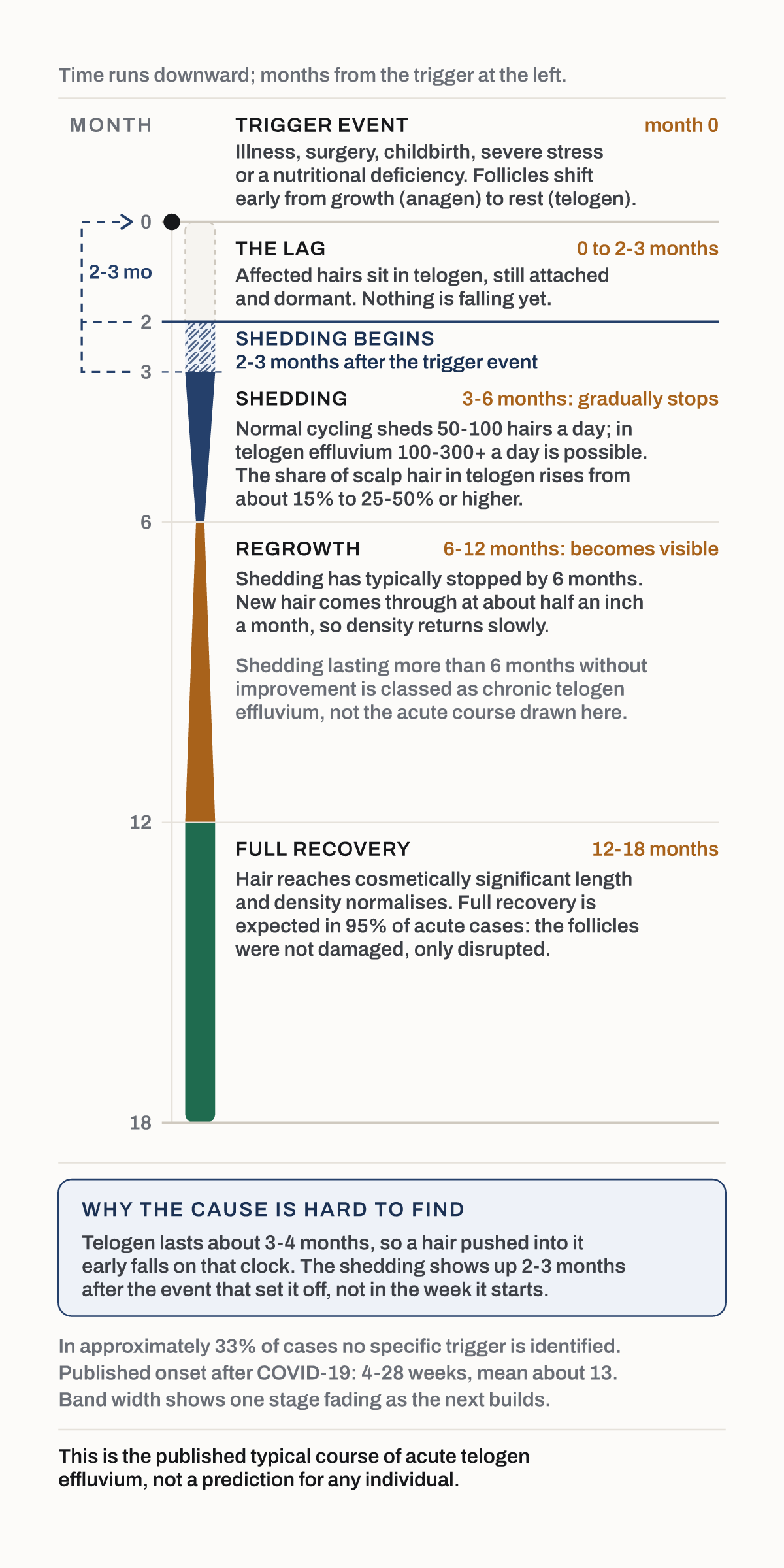
Every number printed on this figure, and where it came from
Each quantity the diagram prints, the sentence it was taken from, and the guide that sentence is in. The build refuses to publish if one of these sentences is no longer in the guide it names.
| Value | What it is, and the sentence behind it | Source guide |
|---|---|---|
| approximately 33% | Share of cases in which no specific trigger is identified “In approximately 33% of cases, no specific trigger is identified.” | Telogen Effluvium: Causes and Recovery Timeline |
| 2-3 months | Delay between the triggering event and visible shedding — the length of the lag band “Hair loss appears 2-3 months after the triggering event” | Telogen Effluvium: Causes and Recovery Timeline |
| 2-3 months | When noticeable shedding begins, marked by the rule across the plate “2-3 months later: Noticeable shedding begins” | Telogen Effluvium: Causes and Recovery Timeline |
| about 3-4 months | How long telogen lasts — the clock the delay runs on “Duration: About 3-4 months” | Telogen Effluvium: Causes and Recovery Timeline |
| 3-6 months | When shedding gradually stops — the taper on the shedding band “3-6 months: Shedding gradually stops” | Telogen Effluvium: Causes and Recovery Timeline |
| 3-6 months | How long shedding takes to stop once the trigger is removed “Shedding takes 3-6 months to stop once the trigger is removed” | Telogen Effluvium: Causes and Recovery Timeline |
| 50-100 hairs a day | Normal daily shedding, the baseline the shedding band is read against “You typically shed 50-100 hairs daily as part of normal cycling” | Telogen Effluvium: Causes and Recovery Timeline |
| 100-300+ hairs a day | Daily shedding reported during the shedding window “100-300+ hairs per day possible” | Stress-Related Hair Loss: Complete Recovery Guide |
| about 15% | Share of scalp hair normally in telogen “About 15% of scalp hair is normally in telogen” | Telogen Effluvium: Causes and Recovery Timeline |
| 25-50% or higher | Share of scalp hair in telogen during telogen effluvium “during TE, this can rise to 25-50% or higher” | Telogen Effluvium: Causes and Recovery Timeline |
| 6-12 months | When regrowth becomes visible — the length of the regrowth band “6-12 months: Regrowth becomes visible” | Telogen Effluvium: Causes and Recovery Timeline |
| about half an inch a month | How fast new hair grows, which is why the recovery band is long “About half an inch per month.” | Telogen Effluvium: Causes and Recovery Timeline |
| more than 6 months | The duration that defines the chronic form, noted against month 6 “Duration: More than 6 months” | Telogen Effluvium: Causes and Recovery Timeline |
| 12-18 months | When full cosmetic recovery is reached — the length of the final band “12-18 months: Full cosmetic recovery” | Telogen Effluvium: Causes and Recovery Timeline |
| 95% | Share of acute cases in which full recovery is expected “In 95% of acute telogen effluvium cases” | Telogen Effluvium: Causes and Recovery Timeline |
| 4-28 weeks | Published post-COVID onset, in line with the classic course drawn here “Onset 4-28 weeks after infection (mean about 13 weeks), in line with classic TE” | Telogen Effluvium: Causes and Recovery Timeline |
Where this figure appears
Telogen Effluvium: Causes and Recovery Timeline