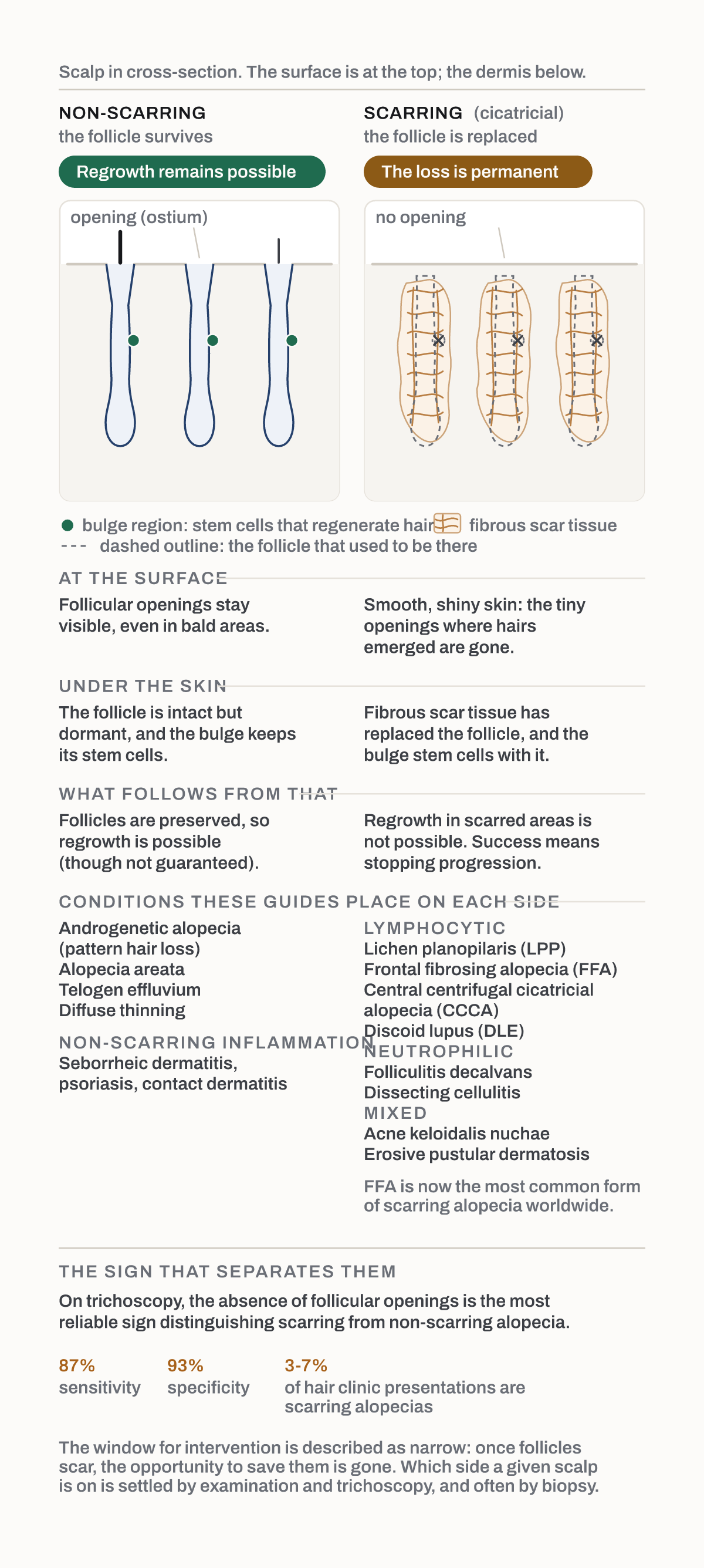
| intact vs replaced | The distinction the whole figure draws
“Unlike non-scarring alopecias where follicles remain intact but dormant” | Scarring Alopecia Types and Management: Complete Guide |
| fibrous scar tissue | What replaces the follicle on the scarring side of the drawing
“scarring alopecias replace follicles with fibrous scar tissue” | Scarring Alopecia Types and Management: Complete Guide |
| scar tissue replaces | Why the right-hand follicle is drawn as a field of collagen, not a shrunken tube
“Scar tissue (fibrosis) gradually replaces the destroyed follicle structures.” | Frontal Fibrosing Alopecia: Complete Guide to Symptoms, Causes & Treatment (2026) |
| remain alive | Why the left-hand follicles are drawn whole even where no hair is emerging
“follicles remain alive even as they shrink, leaving the door open for regrowth” | Frontal Fibrosing Alopecia: Complete Guide to Symptoms, Causes & Treatment (2026) |
| dormant, not dead | The state of the middle follicle on the left: an open pore with nothing growing from it
“the follicles themselves aren't destroyed. They're dormant, not dead” | Alopecia Areata: Types, Treatment, and Outlook |
| openings retained | Why the left-hand skin line is drawn broken by three follicular openings
“In non-scarring alopecia, even bald areas retain these openings” | Scarring Alopecia Types and Management: Complete Guide |
| no openings | Why the right-hand skin line is drawn unbroken
“the skin no longer has the tiny openings (ostia) where hairs emerge” | Scarring Alopecia Types and Management: Complete Guide |
| featureless | How the scarred surface reads to the eye
“Affected areas appear featureless without visible hair openings” | Frontal Fibrosing Alopecia: Complete Guide to Symptoms, Causes & Treatment (2026) |
| openings present or absent | The comparison the two panels are built to make
“Scarring alopecia shows smooth, shiny scalp without visible follicular openings. Non-scarring alopecia retains these openings even in bald areas.” | Scarring Alopecia Types and Management: Complete Guide |
| absent follicular openings | The most reliable sign distinguishing the two on trichoscopy
“Absence of follicular openings (ostia)” | Scarring Alopecia Types and Management: Complete Guide |
| bulge region | What the marked node on the left-hand follicles is, and why it is marked
“housing stem cells that regenerate hair through multiple growth cycles” | Scarring Alopecia Types and Management: Complete Guide |
| stem cells | The bulge as the site of the hair follicle stem cells
“the **bulge region**, which houses hair follicle stem cells” | Frontal Fibrosing Alopecia: Complete Guide to Symptoms, Causes & Treatment (2026) |
| destroyed | Why the same node on the right-hand follicles is struck through
“Once the bulge is destroyed and replaced by collagen scar tissue” | Scarring Alopecia Types and Management: Complete Guide |
| regrowth possible | The consequence, as C03 states it for alopecia areata; the general form the plate prints is folliclesAlive, above
“Because follicles are preserved, regrowth is always possible” | Alopecia Areata: Types, Treatment, and Outlook |
| not possible | The consequence stated on the scarring side
“Regrowth in scarred areas is not possible” | Scarring Alopecia Types and Management: Complete Guide |
| stopping progression | What treatment achieves on the scarring side
“Success means stopping progression” | Scarring Alopecia Types and Management: Complete Guide |
| narrow | Why the plate closes on the timing rather than on the treatment
“The window for intervention is narrow” | Scarring Alopecia Types and Management: Complete Guide |
| no regrowth | The same point as the scalp-inflammation guide states it
“once follicles are destroyed, regrowth isn't possible” | Scalp Inflammation: Signs, Causes, and Treatment Guide |
| NAHRS | Where the three groups on the scarring side come from
“the North American Hair Research Society established a classification system for primary cicatricial alopecias” | Scarring Alopecia Types and Management: Complete Guide |
| lymphocytic | First group heading on the scarring side
“inflammation characterizes the most common scarring alopecias” | Scarring Alopecia Types and Management: Complete Guide |
| neutrophilic | Second group heading on the scarring side
“inflammation creates pustular, often painful conditions” | Scarring Alopecia Types and Management: Complete Guide |
| mixed | Third group heading on the scarring side
“Both lymphocytes and neutrophils” | Scarring Alopecia Types and Management: Complete Guide |
| LPP | Lichen planopilaris, listed as lymphocytic
“**Lichen Planopilaris (LPP)**: Multifocal patches with perifollicular scaling” | Scarring Alopecia Types and Management: Complete Guide |
| FFA | Frontal fibrosing alopecia, listed as lymphocytic
“**Frontal Fibrosing Alopecia (FFA)**: Band-like recession with eyebrow loss” | Scarring Alopecia Types and Management: Complete Guide |
| most common | The note under the scarring list, and the reason C06 carries this plate
“most common form of scarring alopecia worldwide” | Frontal Fibrosing Alopecia: Complete Guide to Symptoms, Causes & Treatment (2026) |
| CCCA | Central centrifugal cicatricial alopecia, listed as lymphocytic
“**Central Centrifugal Cicatricial Alopecia (CCCA)**: Vertex-starting, spreading outward” | Scarring Alopecia Types and Management: Complete Guide |
| DLE | Discoid lupus erythematosus, listed as lymphocytic
“**Discoid Lupus Erythematosus (DLE)**: Associated with systemic lupus” | Scarring Alopecia Types and Management: Complete Guide |
| folliculitis decalvans | Listed as neutrophilic
“**Folliculitis Decalvans**: Pustules with characteristic” | Scarring Alopecia Types and Management: Complete Guide |
| dissecting cellulitis | Listed as neutrophilic
“**Dissecting Cellulitis**: Painful nodules and interconnecting sinuses” | Scarring Alopecia Types and Management: Complete Guide |
| acne keloidalis nuchae | Listed as mixed
“**Acne Keloidalis Nuchae**: Firm papules on posterior neck/scalp” | Scarring Alopecia Types and Management: Complete Guide |
| erosive pustular dermatosis | Listed as mixed
“**Erosive Pustular Dermatosis**: Rare, often post-surgical or post-radiation” | Scarring Alopecia Types and Management: Complete Guide |
| pattern hair loss | Placed outside the scarring group by C07
“You have pattern hair loss without scalp scarring” | Scarring Alopecia Types and Management: Complete Guide |
| alopecia areata | Placed outside the scarring group by C07
“You have patchy hair loss with regrowth potential” | Scarring Alopecia Types and Management: Complete Guide |
| telogen effluvium | Placed outside the scarring group by C07
“You have temporary hair loss from stress” | Scarring Alopecia Types and Management: Complete Guide |
| diffuse thinning | Placed outside the scarring group by C07
“You're experiencing general thinning without inflammation” | Scarring Alopecia Types and Management: Complete Guide |
| seborrheic dermatitis, psoriasis, contact dermatitis | Inflammatory scalp conditions the scalp-inflammation guide places on the non-scarring side
“Non-scarring inflammatory conditions (seborrheic dermatitis, psoriasis, contact dermatitis) don't typically cause permanent loss” | Scalp Inflammation: Signs, Causes, and Treatment Guide |