RegrowProtocol

Figures

Mature hairline or receding hairline

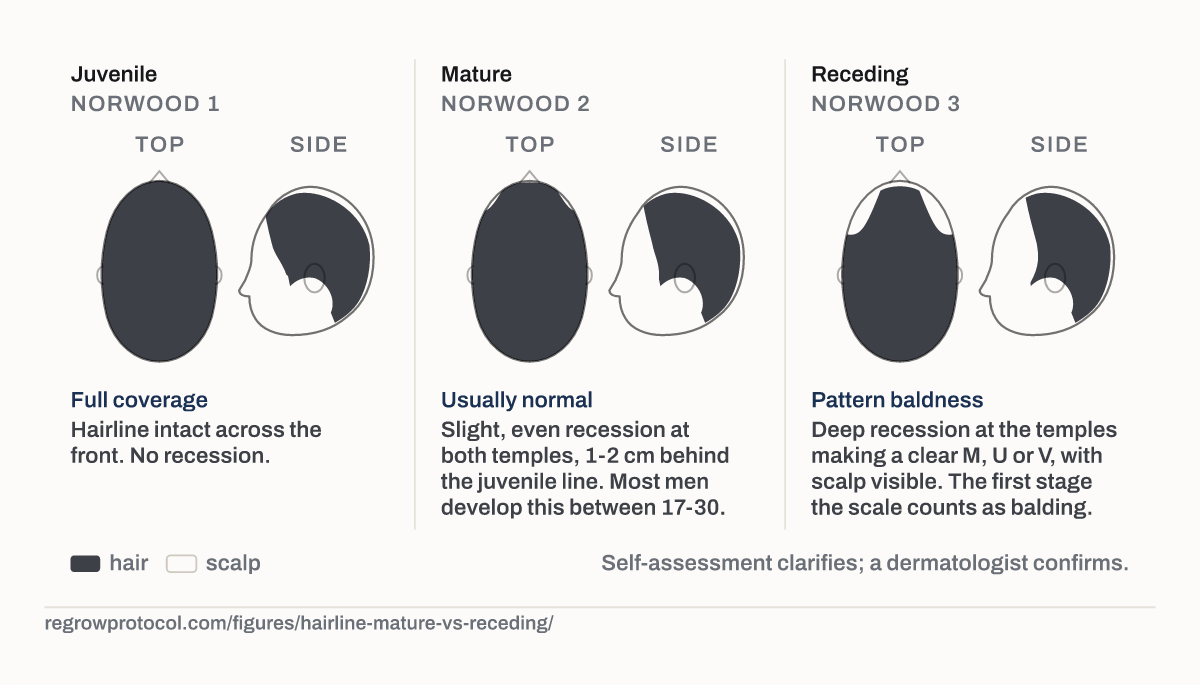
Three hairlines seen from above and in profile: the juvenile hairline of Norwood 1, the mature hairline of Norwood 2, which most men develop between 17 and 30 and which sits 1-2 cm behind the juvenile line, and the pronounced M of Norwood 3, the first stage the scale counts as balding. The difference between the second and third heads is the whole question; shaded areas are hair, pale areas are scalp.

Free to use anywhere, including commercially, with a visible link back to this page. Licensing without the credit line.

Mature hairline or receding hairline.
Use this figure on your own site

Free to use anywhere, including commercially, if you keep a visible link back to this page. It is drawn from the sources cited beneath it and follows your reader's light or dark theme.

Open the SVG directly · PNG, 1200px wide · All figures

Every number printed on this figure, and where it came from

Each quantity the diagram prints, the sentence it was taken from, and the guide that sentence is in. The build refuses to publish if one of these sentences is no longer in the guide it names.

ValueWhat it is, and the sentence behind itSource guide
1-2 cmHow far the mature hairline sits behind the juvenile one — the depth drawn on the middle head
“This typically involves minor recession of 1-2 centimeters and often corresponds to Norwood Stage 2.”
How to Tell If You're Going Bald: Early Signs & Self-Assessment Guide (2026)
17-30 yearsThe age range over which the mature hairline normally forms
“most men develop this naturally between ages 17-30”
How to Tell If You're Going Bald: Early Signs & Self-Assessment Guide (2026)
What is behind the drawing (6 entries)

Shapes carry claims as much as printed numbers do, and some quantities shape the drawing without appearing in it. Each entry below names the sentence that justifies it.

Drawn asThe decision, and the sentence behind itSource guide
1The left-hand head, drawn with the hairline intact across the front
“Full coverage, juvenile hairline.”
How to Tell If You're Going Bald: Early Signs & Self-Assessment Guide (2026)
not necessarily pattern baldnessWhy the middle head is labelled as usually normal
“This is often called a "mature hairline" and isn't necessarily pattern baldness”
How to Tell If You're Going Bald: Early Signs & Self-Assessment Guide (2026)
2The middle head, drawn as slight, even recession at both temples
“Slight recession at the temples.”
How to Tell If You're Going Bald: Early Signs & Self-Assessment Guide (2026)
3The right-hand head, drawn with a deep M at the temples
“Deep recession at the temples creates a clear M, U, or V shape.”
How to Tell If You're Going Bald: Early Signs & Self-Assessment Guide (2026)
pattern baldnessWhy the right-hand head is labelled as the first stage of pattern loss
“When recession continues beyond the mature hairline, creates a pronounced M-shape with visible scalp at the temples, or is accompanied by crown thinning, it suggests pattern baldness.”
How to Tell If You're Going Bald: Early Signs & Self-Assessment Guide (2026)
self-assessment, and professional consultationThe last line of the plate
“Photo documentation, self-assessment, and professional consultation can clarify what you're experiencing and what you can do about it.”
How to Tell If You're Going Bald: Early Signs & Self-Assessment Guide (2026)

Where this figure appears

How to Tell If You're Going Bald: Early Signs & Self-Assessment Guide (2026)

Other figures