Scalp cooling: what the trials show, and what they do not
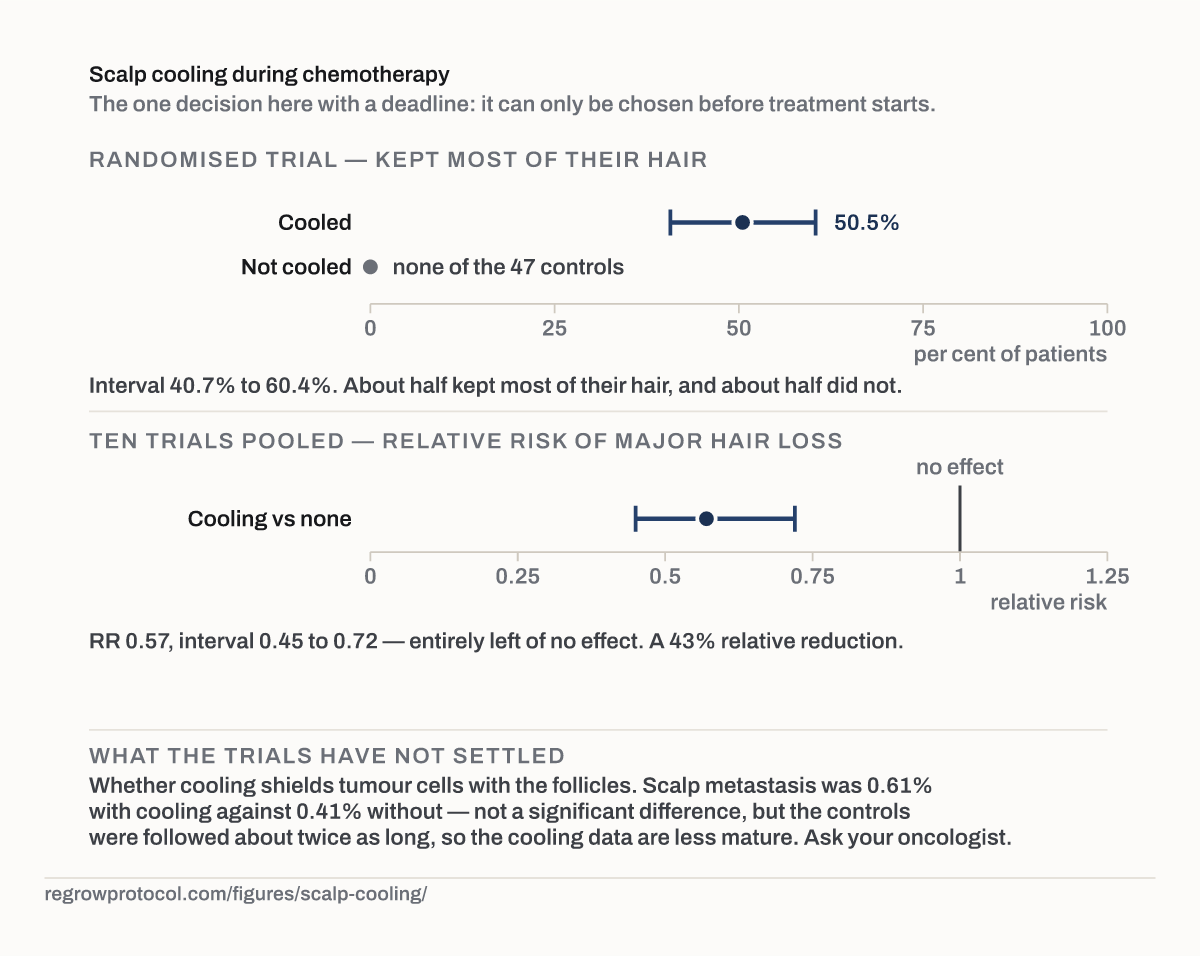
The randomised evidence for scalp cooling during chemotherapy, on two scales. Above, the proportion of women meeting the hair-preservation endpoint in the SCALP trial, with its confidence interval, against none of the controls. Below, the pooled relative risk of major hair loss from ten trials, where 1 is no effect. The footer carries the question the trials have not settled. This is the one decision on this site with a deadline: it can only be chosen before treatment starts.
Free to use anywhere, including commercially, with a visible link back to this page. Licensing without the credit line.

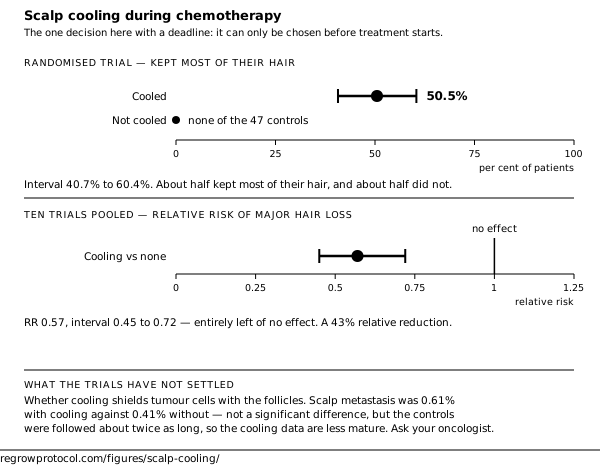
Every number printed on this figure, and where it came from
Each quantity the diagram prints, the sentence it was taken from, and the guide that sentence is in. The build refuses to publish if one of these sentences is no longer in the guide it names.
| Value | What it is, and the sentence behind it | Source guide |
|---|---|---|
| 50.5% | Proportion of cooled women meeting the hair-preservation endpoint in the randomised trial “48 of 95 (50.5%; 95% CI 40.7%-60.4%) met grade 0-1 preservation vs 0 of 47 controls” | Chemotherapy Hair Loss: Which Drugs Cause It, What Scalp Cooling Achieves, and the Regrowth Timeline |
| 40.7% | Lower bound of the confidence interval on that proportion “48 of 95 (50.5%; 95% CI 40.7%-60.4%) met grade 0-1 preservation vs 0 of 47 controls” | Chemotherapy Hair Loss: Which Drugs Cause It, What Scalp Cooling Achieves, and the Regrowth Timeline |
| 60.4% | Upper bound of the confidence interval on that proportion “48 of 95 (50.5%; 95% CI 40.7%-60.4%) met grade 0-1 preservation vs 0 of 47 controls” | Chemotherapy Hair Loss: Which Drugs Cause It, What Scalp Cooling Achieves, and the Regrowth Timeline |
| 0.57 RR | Pooled relative risk of major hair loss with cooling, where 1 is no effect “scalp cooling reduced relative risk (RR) of alopecia by 43% (RR, 0.57; 95% CI, 0.45-0.72; I2 = 11%; P < .00001)” | Chemotherapy Hair Loss: Which Drugs Cause It, What Scalp Cooling Achieves, and the Regrowth Timeline |
| 0.45 RR | Lower bound of the pooled relative risk interval “scalp cooling reduced relative risk (RR) of alopecia by 43% (RR, 0.57; 95% CI, 0.45-0.72; I2 = 11%; P < .00001)” | Chemotherapy Hair Loss: Which Drugs Cause It, What Scalp Cooling Achieves, and the Regrowth Timeline |
| 0.72 RR | Upper bound of the pooled relative risk interval “scalp cooling reduced relative risk (RR) of alopecia by 43% (RR, 0.57; 95% CI, 0.45-0.72; I2 = 11%; P < .00001)” | Chemotherapy Hair Loss: Which Drugs Cause It, What Scalp Cooling Achieves, and the Regrowth Timeline |
| 43% | The same pooled result stated as a relative reduction “scalp cooling reduced relative risk (RR) of alopecia by 43% (RR, 0.57; 95% CI, 0.45-0.72; I2 = 11%; P < .00001)” | Chemotherapy Hair Loss: Which Drugs Cause It, What Scalp Cooling Achieves, and the Regrowth Timeline |
| 0.61% | Scalp metastasis incidence among cooled patients “The incidence of scalp metastasis was 0.61% (95% CI 0.32-1.1%) with cooling versus 0.41% (95% CI 0.13-0.94%) without cooling (P = 0.43)” | Chemotherapy Hair Loss: Which Drugs Cause It, What Scalp Cooling Achieves, and the Regrowth Timeline |
| 0.41% | Scalp metastasis incidence among controls “The incidence of scalp metastasis was 0.61% (95% CI 0.32-1.1%) with cooling versus 0.41% (95% CI 0.13-0.94%) without cooling (P = 0.43)” | Chemotherapy Hair Loss: Which Drugs Cause It, What Scalp Cooling Achieves, and the Regrowth Timeline |
Where this figure appears
Chemotherapy Hair Loss: Which Drugs Cause It, What Scalp Cooling Achieves, and the Regrowth Timeline