The Norwood scale, stages 1 to 7 and the Type A variant
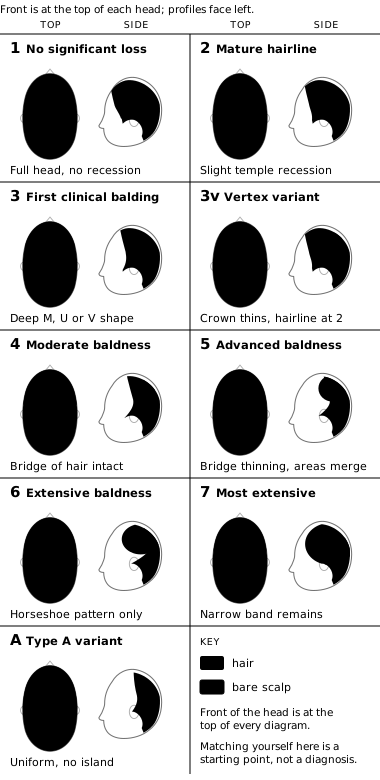
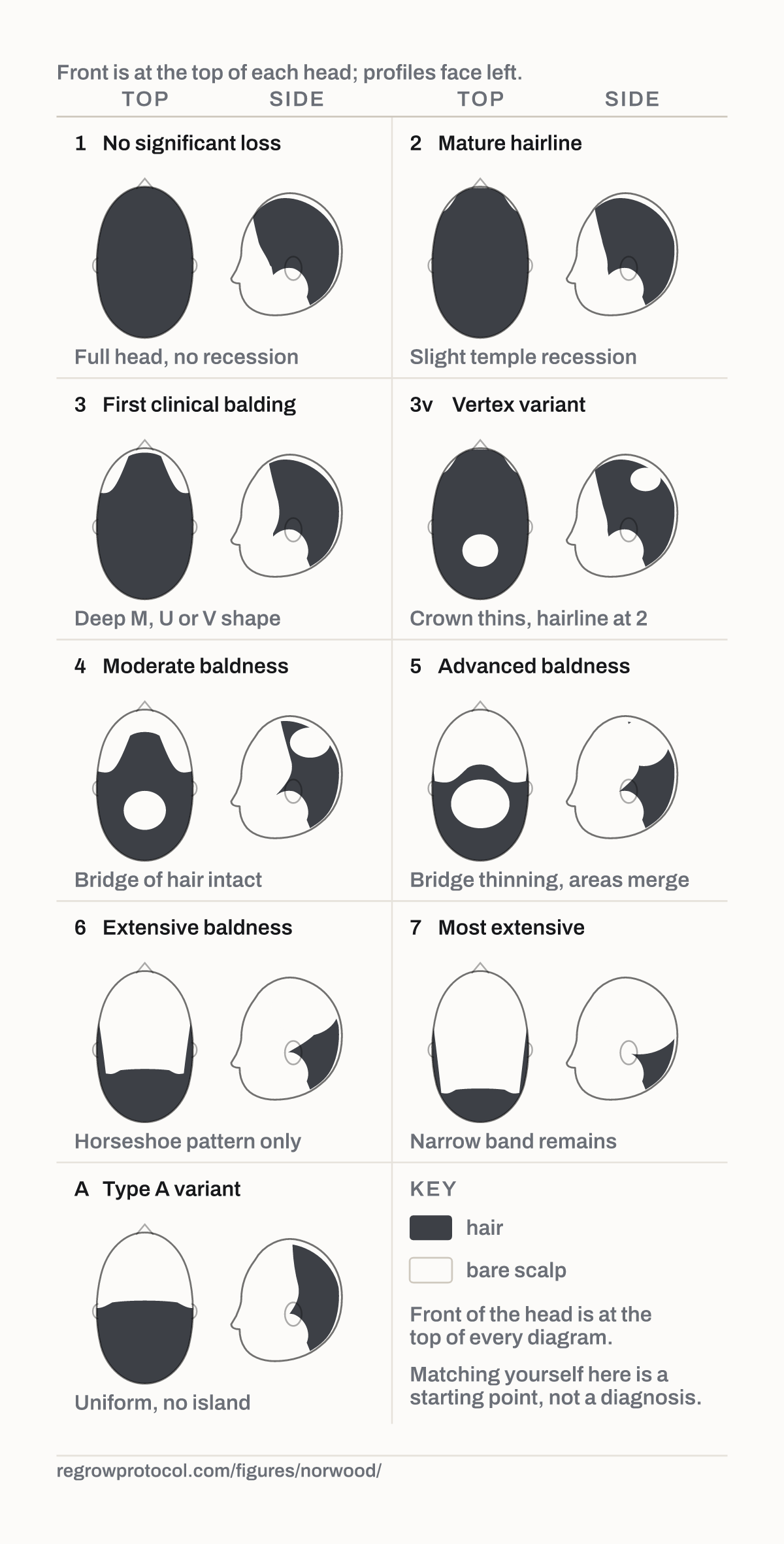
Each stage is drawn twice: the top of the head with the front at the top, and the profile facing left. Shaded areas are hair, pale areas are bare scalp. Stage 2 is usually a mature hairline rather than balding; Stage 3 is the first stage the scale counts as clinical balding. The Type A variant recedes uniformly from front to back instead of leaving an island of hair in the middle, and shows no separate crown loss.
Free to use anywhere, including commercially, with a visible link back to this page. Licensing without the credit line.

Every number printed on this figure, and where it came from
Each quantity the diagram prints, the sentence it was taken from, and the guide that sentence is in. The build refuses to publish if one of these sentences is no longer in the guide it names.
| Value | What it is, and the sentence behind it | Source guide |
|---|---|---|
| 7 stages | Stages on the Norwood scale, minimal loss through extensive baldness “with 7 stages from minimal loss (Stage 1) to extensive baldness (Stage 7)” | The Norwood Scale Explained: Find Your Stage of Hair Loss (2026) |
| 1-2 cm | How far a Stage 2 hairline sits behind the juvenile one — the depth drawn at stage 2 “recession is typically 1-2 centimeters from the juvenile hairline” | The Norwood Scale Explained: Find Your Stage of Hair Loss (2026) |
| 3% | Share of men whose loss follows the Type A pattern, which is why it is drawn alongside 1-7 “Approximately 3% of men with pattern baldness follow the Type A progression pattern” | The Norwood Scale Explained: Find Your Stage of Hair Loss (2026) |
Where this figure appears
The Norwood Scale Explained: Find Your Stage of Hair Loss (2026)